Sylhet and Sreemangal Travel Guide 2026: Ratargul, Jaflong, Bichanakandi, Lalakhal and Tea Gardens
Swamp forests, turquoise rivers under the Meghalaya hills, endless tea estates and a rainforest with gibbons. This is how to plan Sylhet and Sreemangal, season by season.

Sylhet is Bangladesh at its greenest. In the far northeast, where the plains meet the hills of Meghalaya, rivers come down clear and fast over beds of stone. Forests stand in water during the monsoon, and tea bushes cover the slopes in neat, endless rows. In a single trip you can float through a swamp forest, watch boats on a blue-green river beneath the hills, sip seven-layer tea in the tea capital, and walk under the canopy of a rainforest where gibbons call.
This guide covers Sylhet city and its river spots (Ratargul, Jaflong, Bichanakandi, Lalakhal) together with Sreemangal and Lawachara, about a two- to three-hour drive south. It explains which season suits which place, how to get there, where to stay and how to plan three days.
Sylhet and Sreemangal at a glance
| Location | Sylhet and Moulvibazar districts, Sylhet division |
| Highlights | Ratargul swamp forest, Jaflong, Bichanakandi, Lalakhal, tea estates, Lawachara National Park |
| From Dhaka | Train ~7 h (Sylhet) / ~4.5 h (Sreemangal); bus ~5–6 h; air ~45 min to Sylhet |
| Best time | Jun–Oct for rivers and Ratargul; Oct–Apr for tea gardens and Lawachara |
| Typical trip | 3–4 days covering both, or 2 days for either |
| Budget | Sylhet ~৳4,000–7,000 (2D); Sreemangal ~৳3,500–6,000 (2D), approximate, shared |
How to get there from Dhaka
To Sylhet city
- Train: Intercity trains on the Dhaka–Sylhet line include the Parabat Express, Jayantika Express, Kalni Express and the overnight Upaban Express. The journey takes roughly 7 hours, and the night train saves you a hotel night. Timetables change, so check Bangladesh Railway and book through the official e-ticketing service.
- Bus: AC and non-AC coaches take around 5–6 hours, depending on traffic.
- Air: Flights to Osmani International Airport take about 45 minutes.
To Sreemangal
- Train: Sreemangal is on the same railway line, about 4.5 hours from Dhaka. Several intercity trains stop here, so confirm the stop when you book.
- Bus: Direct buses run from Dhaka.
- From Sylhet city: a few hours by road. Many travellers do Sylhet first, then Sreemangal on the way back to Dhaka, or the other way round.
Best time to visit, place by place
| Place | Best months | Why |
|---|---|---|
| Ratargul | Jun – Sep | The forest floods and you explore it by boat. In the dry season the water drops a lot. |
| Bichanakandi | Jun – Oct | Streams run full over the stone beds. In the dry season there is little water. |
| Lalakhal | Jul – Nov (water colour at its best after the rains) | Blue-green water, with boat rides to tea-garden villages |
| Jaflong | Jun – Oct | Full Piyain river and green hills, with good views of the Dauki bridge |
| Sreemangal and Lawachara | Oct – Apr (good year-round) | Comfortable weather for walks, fresh tea flush in spring |
Monsoon caution: the Sylhet region is prone to flash floods, and some years bring severe flooding. During heavy rain, check forecasts and local news, keep plans flexible, and follow any administration notices about boats and river access.
Sylhet: the river and forest circuit
Ratargul Swamp Forest
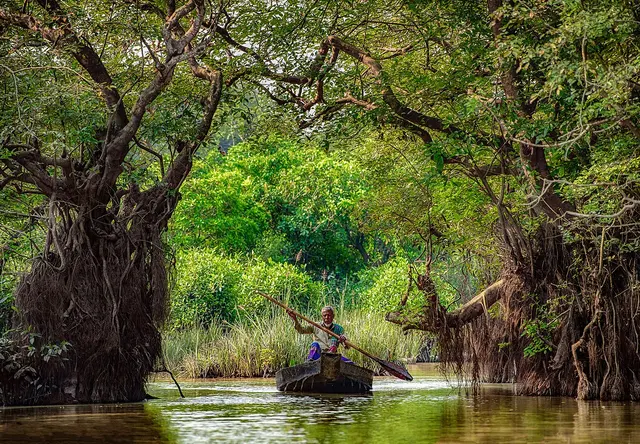
In Gowainghat upazila, Ratargul is a freshwater swamp forest. In the monsoon its trees stand chest-deep in water, and you glide between them in small wooden boats rowed by local boatmen. The light is green and the water dark and still. It is quiet except for the birds and the dipping oars.
- How to visit: go by road from Sylhet city to the boat point, then hire a boat. The Forest Department charges a small entry fee and has set boat charges in the past. Check the current rates on site.
- Timing: go early to avoid crowds. In the dry season the water may be too low to explore the forest properly.
- Note: the forest is shrinking under pressure from encroachment and pollution. Don't throw anything in the water, and keep noise down.
Jaflong
About 1.5 hours from Sylhet city, Jaflong sits on the Piyain river at the border, with the forested hills of Meghalaya rising across it. You will see the Dauki suspension bridge on the Indian side, boats on the river, and Khasi villages and betel-leaf gardens nearby. Jaflong is an ecologically critical area, and local authorities have at times set boat-safety rules, such as compulsory life jackets and limits on young children on boats. Follow whatever is posted.
Be aware: news reports from 2024–25 describe large-scale illegal stone extraction at Jaflong, followed by enforcement drives. Parts of the riverbed look very different from older photos.

Bichanakandi
Bichanakandi is a valley where streams from the Meghalaya hills spread over a wide bed of stones. In the monsoon, clear water rushes over the stones with the hills right in front of you. Visitors usually go by road from Sylhet and then by boat for the last stretch. The full trip from the city takes about 1–1.5 hours.
Bichanakandi has also been named in reports of stone looting in the region, alongside Bholaganj Sada Pathor, a nearby "white stone" spot that was reported to be largely stripped by 2025. Check recent local news before making either a centrepiece of your trip.

Lalakhal
In Jaintiapur, about 1–1.5 hours from Sylhet city, Lalakhal is known for its blue-green river water. Hire a boat from the ghat and float upstream past sandbanks and tea-covered hills. The colour is often best in the clear weeks after the monsoon. Lalakhal pairs well with Jaflong on the same day, since both lie along the Sylhet–Tamabil road.

In Sylhet city
- Shrine of Hazrat Shah Jalal: Sylhet's spiritual heart, visited by people from across the country. Dress modestly and follow the shrine's customs.
- Shrine of Hazrat Shah Paran, on the city's edge.
- Keane Bridge and the Surma riverfront at sunset.
- Tea estates near the city, such as the gardens around Malnicherra and the airport road, are good for a short visit if you won't reach Sreemangal.
Further afield: Tanguar Haor
If you visit in the monsoon and have two extra days, a houseboat trip on Tanguar Haor in Sunamganj, a Ramsar wetland, is one of the great Bangladesh experiences. See our Tanguar Haor guide.
Sreemangal and Lawachara: tea country
The tea gardens
Sreemangal in Moulvibazar is called the "tea capital of Bangladesh". Rolling estates stretch in every direction, with neat tea bushes under tall shade trees and pickers working the rows. Many estates allow visitors to walk on their roads. Always ask permission before entering private areas or photographing workers. The Bangladesh Tea Research Institute is also in Sreemangal.

Seven-layer tea
Sreemangal is famous for seven-layer tea: a glass of tea in separate coloured layers, each with its own flavour. It is a fun local invention and worth trying once.
Lawachara National Park
About 1,250 hectares of hill forest, declared a national park in 1996, Lawachara is one of the best-known forests in Bangladesh. It is home to the endangered western hoolock gibbon. Recent counts suggest only around 50 individuals remain, so sightings are a privilege. You may also see langurs, macaques and many birds. Marked walking trails of different lengths start near the entrance, and a local guide improves your chances of spotting wildlife.
The railway line through the forest is one of the most photographed spots in the country. Trains still use it, so stay off the track and never stand on it for photos.

Around Sreemangal
- Madhabpur Lake, a lake set among tea hills in nearby Kamalganj.
- Baikka Beel, a wetland sanctuary in Hail Haor, good for winter birdwatching.
- Indigenous villages: Khasi and Manipuri communities live in the area. Visit respectfully, ideally with a local guide.
Where to stay
- Sylhet city: hotels and guesthouses in all ranges, mainly around the city centre, Zindabazar and the airport road. This is the most practical base for day trips to Ratargul, Jaflong, Bichanakandi and Lalakhal.
- Near Jaflong and Jaintiapur: a few simpler options and resorts for those who want an early start on the river.
- Sreemangal: a wide choice of tea-garden resorts, eco-cottages and town hotels. Staying among the gardens is part of the experience. Book ahead for winter weekends.
Food to try
- Satkora beef or mutton curry: cooked with satkora, a fragrant Sylheti citrus. This is the region's signature dish.
- Seven-layer tea in Sreemangal, and plenty of ordinary, excellent fresh tea everywhere.
- Haor and river fish: fresh fish curries, especially in the monsoon.
- Sylheti pitha and snacks, and seasonal fruit such as pineapple and orange from the hill areas.
- Khasi and Manipuri dishes, if you find a local home-style eatery.
Sample 3-day itinerary (Sylhet and Sreemangal)
Night 0: Dhaka to Sylhet. Take the overnight train or a night bus.
Day 1: Ratargul and Bichanakandi.
- Arrive early and have breakfast.
- Take the morning boat ride at Ratargul.
- Spend the afternoon at Bichanakandi (monsoon), then return to the city.
- Visit the Hazrat Shah Jalal shrine in the evening, then a satkora dinner.
Day 2: Lalakhal and Jaflong.
- Take a morning boat on Lalakhal.
- Continue along the Tamabil road to Jaflong for the river, hills and Dauki views.
- Return to Sylhet, or drive on towards Sreemangal (a long day).
Day 3: Sreemangal and Lawachara.
- Take a morning trail walk in Lawachara and look for gibbons.
- Walk the tea estates and try seven-layer tea.
- Take the evening train from Sreemangal to Dhaka.
With more time: add a night in a tea-garden resort, a dawn visit to Baikka Beel in winter, or a Tanguar Haor houseboat in the monsoon.
Estimated budget (per person)
These are approximate ranges for planning, based on group sharing. Prices vary with season, transport and hotel class. Verify before you travel.
| Item | Approximate range | Notes |
|---|---|---|
| Sylhet trip (2 days) | ≈ ৳4,000 – ৳7,000 | Train or bus, shared transport to spots, mid-range stay |
| Sreemangal trip (2 days) | ≈ ৳3,500 – ৳6,000 | Train, simple resort or hotel, local transport |
| Boat hire (Ratargul, Lalakhal, Bichanakandi) | Per boat, shared | Agree price and duration before boarding |
| Entry fees (Ratargul, Lawachara) | Small amounts | Set by the Forest Department |
| Combined 3–4 day trip | A little under the two ranges added together | You share one journey from Dhaka |
Safety and rules
- Water safety first. Hill rivers like those at Jaflong and Bichanakandi can rise and run fast with no warning after rain upstream. Don't bathe where the current is strong, wear life jackets on boats, and keep children close.
- Border awareness. Jaflong, Bichanakandi and Lalakhal are right on the India border. Do not cross the border markers or follow anyone who invites you to. Obey BGB instructions.
- Respect protected areas. Ratargul, Jaflong and Lawachara are protected forests or ecologically critical areas. Don't remove stones, plants or animals, don't feed wildlife, and don't litter.
- Railway line at Lawachara: trains pass regularly. Never sit, walk or pose on the tracks.
- Flash-flood season: follow administration notices. Spots may close temporarily after heavy rain.
- Shrines and villages: dress modestly and ask before photographing people.
Practical tips
- Hire a car or CNG for the day for the river spots. Distances are short, but public transport is slow.
- Carry cash for boats, entry fees and snacks.
- Pack a light rain jacket, quick-dry clothes and sandals with grip in the monsoon. Bring insect repellent for Lawachara and Ratargul.
- Start early. Boats and trails are calmer and cooler in the morning, and wildlife is more active.
- Check spot status. Some places have changed after the 2024–25 stone extraction, and access rules can change with river levels.
Travel with a group
Sylhet works well with a small group: one vehicle, shared boats and a local guide who knows which spot is good this week. BanglaTrips runs Sylhet, Ratargul and tea-garden group tours. See upcoming departures on our Ratargul and Sreemangal & Lawachara pages, and plan ahead with our Jaflong and Bichanakandi & Lalakhal guides.
Frequently asked questions
What is the best time to visit Sylhet? June to October for Ratargul and the rivers. October to April for Sreemangal's tea gardens and Lawachara.
How do I get from Dhaka to Sylhet? Train (~7 h), bus (~5–6 h) or air (~45 min).
How do I get to Sreemangal? By train (~4.5 h from Dhaka), or by road from Sylhet city.
Is Ratargul worth visiting in winter? It is much better in the monsoon, when the forest is flooded.
Are Jaflong and Bichanakandi still worth it? Yes, especially in the monsoon, but stone extraction in 2024–25 has changed parts of the landscape.
How much does it cost? About ৳4,000–7,000 (Sylhet, 2D) and ৳3,500–6,000 (Sreemangal, 2D) per person (approximate).
Can I see hoolock gibbons in Lawachara? Possibly, with an early start, a guide and patience.
Last updated: October 2026
Frequently asked questions
What is the best time to visit Sylhet?
It depends on what you want. For Ratargul, Bichanakandi, Lalakhal and Jaflong, June to October is best, when the rivers are full and the forest is flooded. Sreemangal's tea gardens and Lawachara are good year-round, but most comfortable from October to April. Watch for flash-flood warnings in the monsoon.
How do I get from Dhaka to Sylhet?
By train (about 7 hours on intercity services such as the Parabat, Jayantika, Kalni and the overnight Upaban Express), by bus (about 5–6 hours) or by air (about 45 minutes to Osmani International Airport). Check Bangladesh Railway for current timetables.
How do I get to Sreemangal?
Sreemangal is on the Dhaka–Sylhet railway, about 4.5 hours from Dhaka by train. Several intercity trains stop there, so check the stops when you book. It is also a few hours by road from Sylhet city.
Is Ratargul worth visiting in winter?
Ratargul is at its best in the monsoon, when the trees stand in water and you explore by boat. In the dry winter months the water drops a lot, and the experience is very different and less striking.
Are Jaflong and Bichanakandi still worth visiting?
They are still scenic, especially in the monsoon. But news reports describe heavy illegal stone extraction in Jaflong, Bichanakandi and nearby Bholaganj Sada Pathor in 2024–25, which has changed parts of the landscape. Set your expectations accordingly and check recent local reports.
How much does a Sylhet and Sreemangal trip cost?
As a rough guide, a 2-day Sylhet trip costs about ৳4,000–7,000 per person and a 2-day Sreemangal trip about ৳3,500–6,000, both shared in a group. Combining both over 3–4 days usually costs a little less than the two added together, because you share one journey from Dhaka. These are approximate, so verify current prices.
Can I see hoolock gibbons in Lawachara?
Possibly. Lawachara is one of the last strongholds of the endangered western hoolock gibbon, but the population is small, recent counts put it at around 50, and the gibbons are shy. Go early in the morning with a local guide and keep quiet.
Sources
Facts were checked against these sources when the guide was written. Conditions change, so confirm before you travel.
- Upaban Express (Wikipedia)en.wikipedia.org
- Parabat Express (Wikipedia)en.wikipedia.org
- Lawachara National Park (Wikipedia)en.wikipedia.org
- Lawachara forest losing its character as wildlife dwindles (Bonik Barta English)en.bonikbarta.com
- The plunder that never stopped: illegal stone, sand extraction persist in Sylhet (The Daily Star)thedailystar.net
- Joint force to be deployed to stop stone theft (Dhaka Tribune)dhakatribune.com
- Govt imposes entry fee for visitors at Ratargul (The Financial Express)old.thefinancialexpress.com.bd