Kuakata Travel Guide 2026: Sunrise and Sunset Beach, Fatrar Char, Lebur Char and Rakhine Villages
One of the few beaches in South Asia where you can watch the sun rise and set over the same sea. This is how to plan Kuakata now that the Padma and Payra bridges have opened the road from Dhaka.

Most Bangladeshis know Kuakata by its nickname, Sagar Kanya, "daughter of the sea". At the southern tip of Patuakhali district, a long, flat beach faces the open Bay of Bengal, and because of the way the coast bends, it is one of the few beaches in South Asia where you can watch the sun rise out of the sea in the morning and sink back into it in the evening. Behind the sand are casuarina groves and coconut palms, fishing villages and the old Rakhine settlements that gave the place its name.
For years Kuakata was hard to reach: a long bus ride with several river ferries, or a night on a launch. Two bridges changed that. The Payra Bridge at Lebukhali opened in October 2021 and removed the last ferry on the Barishal–Kuakata road, and the Padma Bridge opened in June 2022. Today Kuakata is a straightforward road trip from Dhaka. This guide covers how to get there, when to go, where the sunrise and sunset points are, Fatrar Char and Lebur Char, the Rakhine villages, food, costs and a three-day plan.
Kuakata at a glance
| Location | Kalapara upazila, Patuakhali district, Barishal division |
| What it is | A beach of roughly 18 km on the Bay of Bengal, known for sunrise and sunset over the sea |
| From Dhaka | Bus ~6–7 h via the Padma Bridge; or overnight launch to Patuakhali/Barishal, then road |
| Best time | November – March |
| Typical trip | 2–3 days |
| Highlights | Sunrise at the eastern end, sunset at Lebur Char, Fatrar Char mangroves, Rakhine villages, Buddhist temples, fishing ports |
| Budget | ≈ ৳4,500–8,000 per person for 2 days, shared (approximate) |
How to get there from Dhaka
By bus (most popular)
Since the Padma Bridge opened, several operators run direct AC and non-AC coaches from Dhaka to Kuakata. The road crosses the Padma Bridge, passes Barishal and Patuakhali, and crosses the Payra river on the Lebukhali bridge. Expect about 6–7 hours, more on Thursday nights and before Eid. Night buses arrive in the early morning, just in time for sunrise. Buses for the southern districts mostly leave from the Sayedabad side of Dhaka, with some operators also picking up elsewhere in the city. Check the operator's counter or website for the current boarding points.
By launch (the slow, scenic option)
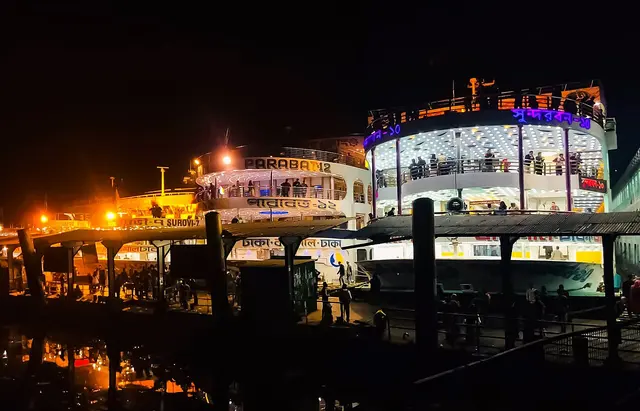
If you want the river experience, take an overnight launch from Sadarghat in Old Dhaka to Patuakhali (or to Barishal) and continue by bus or microbus to Kuakata. Patuakhali town is about 70 km from Kuakata. Launches leave in the evening and arrive early the next morning. It is slower than the bus, but you sleep in a cabin and wake up on the rivers of the south. Read our Barishal launch guide for how cabins, tickets and launch safety work. Launch numbers on southern routes have fallen since the Padma Bridge opened, and services are sometimes suspended in dense fog or bad weather, so confirm before you plan around one.
By air plus road
There is no airport at Kuakata. You can fly from Dhaka to Barishal and continue by road, which takes a few hours. This rarely saves much time over the night bus once you add the transfers.
Getting around Kuakata
Motorbikes with local riders, battery-run autos and vans wait near the zero point. Many travellers hire a motorbike with a rider-guide for the sunrise and sunset points along the beach. Agree the route and the price before you start. Engine boats for Fatrar Char leave from the beach area.

Best time to visit
| Season | Months | What to expect |
|---|---|---|
| Winter (best) | Nov – Feb | Clearer skies for sunrise and sunset, calm sea, comfortable days, cool nights. Busiest on weekends and holidays. |
| Early summer | Mar – May | Hot and humid, hazier sky. Fewer crowds. Nor'westers and early cyclone risk from April. |
| Monsoon | Jun – Sep | Green and cheap, dramatic clouds, but rough sea, frequent rain and storm signals. Boat trips may be cancelled. |
| Autumn | Oct | Rains easing, skies clearing. A good shoulder month, but watch for late-season cyclones. |
Kuakata sits on a cyclone-prone coast. Whatever the season, check the Bangladesh Meteorological Department forecast and any maritime signal before you go, and follow local instructions if a signal is raised.
Things to do
Watch the sunrise and the sunset
This is why people come. The sand runs east to west, so the eastern end is your sunrise side and the western end your sunset side.
- Sunrise: head east from the zero point towards Gangamati (a casuarina and mangrove patch at the eastern end) and the stretch locals call the crab beach, where small red crabs scuttle over the sand at dawn. Leave about 45 minutes before sunrise by motorbike.
- Sunset: the western beach near Lebur Char is the classic spot, with the mangroves of Fatrar Char across the water. The main beach near the zero point also works and is livelier.
Haze is common, especially in the warmer months. A clear sun on the horizon is never guaranteed, so give yourself at least two mornings.

Fatrar Char (Fatrar Bon)
Across the river mouth west of the beach lies Fatrar Char, a mangrove forest that the Bangladesh Tourism Board describes as part of the wider Sundarbans mangrove belt. It now falls within the Tengragiri Wildlife Sanctuary. Engine boats from the Kuakata side take you through a wide channel lined with half-submerged trees, and you can walk a short way into the forest. Birds are common, and you may see monkeys. There are no shops or places to stay on the char, so carry water and snacks, and bring everything back with you. Boat departures depend on the tide and the weather, so ask the boatmen the day before.
Lebur Char
Lebur Char is a quieter stretch on the western side, with a small mangrove patch, a view across to Fatrar Char and an open horizon for sunset. It is popular with travellers who find the main beach too busy. Local boats and motorbikes go there. Check the tide, because parts of the shoreline flood at high water.
Rakhine villages and Buddhist temples
Kuakata's name comes from kua, the Bangla word for well. According to local history, Rakhine settlers who arrived on this coast in the late 18th century dug wells for drinking water, and an old well still stands near the start of Keranipara, the Rakhine village beside the Seema Buddhist temple. Inside the temple is a large meditating Buddha cast in ashtadhatu (an eight-metal alloy). About 8 km east, the Misripara Buddhist temple holds another very large Buddha statue.
Rakhine households are known for handloom weaving, and you can buy shawls, lungis and bags woven in the villages. Visit respectfully: dress modestly at the temples, take off your shoes where asked, and ask before you photograph people or homes.

Fishing ports and dried-fish yards
Alipur and Mohipur, a few kilometres north of the beach, are among the busiest fishing centres on this coast. Early morning is the time to watch trawlers unload. Along the beach you will also see shutki (dried fish) yards, with fish laid out on bamboo racks in the sun in the dry season. The smell is strong, but it is a real slice of coastal life.
The beach itself
Walk the casuarina belt, ride a beach bike or horse, or just sit at a tea stall and watch the fishing boats. The forest department's Kuakata National Park and eco-park areas behind the beach give some shade. Erosion has eaten into parts of the beach and its trees over the years, so the shoreline you see may differ from older photos.
Rash Purnima and Maghi Purnima
Kuakata is also a pilgrimage site for Hindu and Buddhist communities. On Rash Purnima (usually around November) and Maghi Purnima (around January or February), thousands of pilgrims come at dawn to bathe in the sea, and a fair spreads along the beach. It is a remarkable sight, but crowds are huge and room rates rise. The dates follow the lunar calendar and change every year, so check them before you plan, and book well ahead if you want to be there. If you want a quiet beach, avoid these days.

Where to stay
- Near the zero point and the main beach road: most hotels, guesthouses and resorts are here, from basic rooms to mid-range hotels with sea-facing balconies. This is the most convenient base, close to food and transport.
- Quieter edges of town: a few resorts sit a little away from the centre, with more space and less noise.
- Government and corporate guesthouses also exist, but they usually need advance permission.
Book ahead for winter weekends, 16 December, New Year and the Rash Purnima and Maghi Purnima festival days, when Kuakata fills up. Check recent reviews and ask whether the room has a generator or IPS backup.
Food to try
- Fresh fish fry at the beach stalls: choose from crab, prawn, pomfret (rupchanda), coral fish and seasonal ilish, and have it fried in front of you. Ask the price by weight before they cook it.
- Crab curry and shrimp in local restaurants.
- Shutki (dried fish) bhuna, if you like strong flavours, and packets of dried fish to take home.
- Coconut water from the beach vendors.
- Barishal-region sweets and doi on the way, if your bus stops at a highway restaurant.
Seafood is the main draw, but quality varies. Eat where the turnover is high and the fish looks fresh.
Sample 3-day itinerary
Night 0: Dhaka to Kuakata. Take a night bus via the Padma Bridge.
Day 1: Beach and sunset.
- Arrive early, check in and rest.
- Walk to the zero point, the old well and the Seema Buddhist temple in Keranipara.
- Have a late lunch of fish fry.
- Watch the sunset from the main beach.
Day 2: Sunrise, Fatrar Char and Lebur Char.
- Ride a motorbike east to Gangamati and the crab beach for sunrise.
- Take a mid-morning boat to Fatrar Char, timed with the tide.
- In the afternoon, go to Lebur Char for a quiet sunset.
Day 3: Villages and ports, then home.
- Watch the morning catch come in at Alipur or Mohipur.
- Visit the Misripara temple and browse Rakhine handloom.
- Take an afternoon or night bus back to Dhaka.
Short on time? A two-day trip still covers one sunrise, one sunset and Fatrar Char if you take night buses both ways.
Estimated budget (per person)
These are approximate ranges for planning, based on group sharing. Prices change with the season, the bus class and the hotel. Verify before you travel.
| Item | Approximate range | Notes |
|---|---|---|
| Dhaka – Kuakata bus (return) | ≈ ৳1,800 – ৳4,000 | Non-AC to AC; higher before holidays |
| Hotel (per night, shared room) | ≈ ৳800 – ৳3,000 | Basic guesthouse to mid-range hotel |
| Food (per day) | ≈ ৳600 – ৳1,500 | More if you eat a lot of seafood |
| Motorbike for sunrise/sunset points | Per bike, shared by two | Agree the route and price first |
| Boat to Fatrar Char | Per seat or per boat | Depends on boat size and tide |
| 2-day trip total | ≈ ৳4,500 – ৳8,000 | Shared, mid-range (approximate) |
Safety and rules
- Swimming: the beach is flat, but currents can be strong and some patches are muddy and soft. Lifeguard cover is limited. Stay in shallow water, never swim at night or alone, and don't go in when a storm signal is up.
- Cyclone signals: if the Meteorological Department raises a signal, boats stop and the beach can be closed. Follow the local administration and your hotel's advice.
- Boats: wear a life jacket on every boat trip, don't board overloaded boats, and don't travel to Fatrar Char in rough weather.
- Beach vehicles: motorbikes and beach bikes run on the sand. Watch out for them, especially with children.
- Protected forests: Fatrar Char and the Kuakata forest areas are protected. Don't cut branches, disturb animals or leave plastic behind.
- Respect: the temples are active places of worship. Dress modestly and ask before photographing people.
Practical tips
- Carry cash. Kuakata has ATMs and mobile banking works, but smaller stalls and boatmen prefer cash.
- Go midweek in winter if you can. Weekends are much busier and prices go up.
- Pack sunscreen, a hat, sandals, a light jacket for winter mornings and a power bank.
- Check the tide for Fatrar Char and Lebur Char. Boatmen and hotel staff will know.
- Combine trips. Kuakata pairs well with Barishal's rivers and, in July–August, the floating guava market. Some travellers continue east to the Sundarbans side through Khulna, but that is a long road trip and needs a licensed operator for the forest itself.
Travel with a group
Kuakata is a natural group trip: one bus, shared motorbikes and boats, and a beach that is more fun with friends. BanglaTrips runs Kuakata group tours in season. See upcoming departures on our Kuakata destination page, and compare it with other beaches in our Cox's Bazar guide and Saint Martin's Island guide.
Frequently asked questions
Can you really see both sunrise and sunset from Kuakata? Yes, on clear days. Sunrise from the eastern end, sunset from the western end.
How long does it take to get from Dhaka? About 6–7 hours by bus via the Padma Bridge, or overnight by launch plus a road transfer.
When is the best time to go? November to March.
Where are the sunrise and sunset points? Gangamati and the crab beach for sunrise, Lebur Char and the main beach for sunset.
Is it safe to swim? In shallow water and calm weather only. Never at night or during a storm signal.
How much does it cost? About ৳4,500–8,000 per person for two days, shared (approximate).
Last updated: October 2026
Frequently asked questions
Can you really see both sunrise and sunset from Kuakata beach?
Yes. The beach curves along the southern tip of the Patuakhali coast and faces open sea to the south, so on clear days you can watch the sun come up over the water from the eastern end and go down over the water from the western end. Haze and cloud often hide one or both, especially in the monsoon, so plan two mornings and two evenings if the views matter to you.
How long does it take to get from Dhaka to Kuakata?
By bus via the Padma Bridge, roughly 6 to 7 hours depending on traffic. By overnight launch you sail from Sadarghat to Patuakhali (or Barishal) and continue by road. Before the Padma and Payra bridges opened, the road trip often took 10 hours or more with ferry waits.
What is the best time to visit Kuakata?
November to March. The sky is clearer for sunrise and sunset, the sea is calmer and boat trips to Fatrar Char run more comfortably. The monsoon (June to September) is green and cheap but rough, with frequent cyclone signals.
Where should I watch the sunrise and the sunset?
Locals usually head east towards Gangamati and the crab beach area for sunrise, and west towards Lebur Char and the Fatrar Char side for sunset. Ask your hotel or a local motorbike guide which point is best that week, because the sand banks shift.
Is it safe to swim at Kuakata?
Only with care. There are strong currents and soft muddy patches in places, and lifeguard cover is limited. Stay in shallow water, never swim at night, at low tide far from shore, or when a storm signal is up, and keep children close.
How much does a Kuakata trip cost?
As a rough guide, a 2-day trip from Dhaka costs about ৳4,500–8,000 per person when shared in a group, including bus, a simple to mid-range room, food and local transport. These are approximate figures, so verify current prices before you go.
Sources
Facts were checked against these sources when the guide was written. Conditions change, so confirm before you travel.
- Kuakata (Wikipedia)en.wikipedia.org
- Kuakata trip becomes easy as Payra bridge opens (Prothom Alo English, 25 October 2021)en.prothomalo.com
- PM opens Payra Bridge to traffic (The Business Standard)tbsnews.net
- Padma Bridge (Wikipedia)en.wikipedia.org
- Fatrar Char, Patuakhali (Bangladesh Tourism Board, Beautiful Bangladesh)beautifulbangladesh.gov.bd
- Padma Bridge opens new door to tourism in Bangladesh (Bangladesh Monitor)bangladeshmonitor.com.bd